

As Advanced Air Mobility moves from vision to reality, one thing is becoming increasingly clear:
AAM is no longer primarily a technology problem.
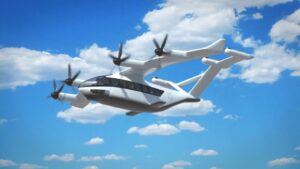
Over the last several years, enormous progress has been made on the propulsion side of the equation. Battery development—once viewed as the gating factor—has accelerated rapidly. Solid-state chemistries, sodium-ion alternatives, large-scale battery storage systems, and advances in fast-charging materials are all moving closer to economic viability and commercial readiness. Momentum is real, industrial investment is substantial, and the trajectory is unmistakable.
Clean propulsion is coming.
But that progress exposes a much more fundamental question—one that remains under-addressed:
With hundreds, thousands, or tens of thousands of clean-propulsion eVTOLs moving through the air… where will they land?
This simple question opens the door to a far more complex reality.
Aircraft are advancing quickly—but the true challenge of AAM lies on the ground:
- How systems launch before everything is perfect
- How infrastructure scales without locking in the wrong assumptions
- How safety, regulation, passenger flow, and capital efficiency operate as a single, coordinated system
AAM’s next constraint is not energy density or propulsion efficiency.
It’s infrastructure, operations, and human experience.
Infrastructure as a System, Not a Monument
We’ve been focused on this layer of AAM—not as fixed monuments or one-off showpieces, but as modular, relocatable, networked infrastructure.
Vertiports should function as operational nodes: repeatable systems that can start small, learn fast, and scale responsibly. They must support today’s transitional aircraft while remaining adaptable to what comes next. Infrastructure cannot be frozen in time while aircraft continue to evolve.
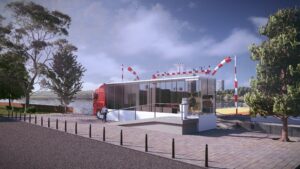
True scalability in AAM infrastructure looks less like permanent megaprojects—and more like LEGO blocks: configurable, reconfigurable, and deployable in phases as demand, regulation, and technology mature.
(Image: mobile, three-stage vertiport rendering)

What the Future of AAM Infrastructure Demands
We believe the most viable AAM infrastructure will be:
- Human-centric, not technology-centric
- Compatible with transitional aircraft, not dependent on a single platform or OEM
- Designed for phased deployment, not all-or-nothing capital bets
- Integrated with operations, safety, data, and brand, not treated as an afterthought
Across regions and programs, the most successful AAM initiatives share a common trait:
they focus less on what looks exciting—and more on what can actually be delivered, operated, and evolved in the real world.
The industry has made remarkable progress in the air.
Now it must do the same on the ground.
That’s the work we’re doing—and the conversations we’re most interested in having.